



Your Path to Financial Fluency in the World’s Largest Market

The Pain: Lost in a $7.5 Trillion Daily Storm
The foreign exchange (forex) market is the largest and most liquid financial market globally, with a daily trading volume exceeding $7.5 trillion. Yet, for the individual, it can feel overwhelmingly vast and impersonal.
- Information Overload: Conflicting advice from forums, YouTube gurus, and expensive courses leaves you more confused than when you started.
- Analysis Paralysis: Should you use technical analysis, fundamental analysis, or a blend of both? The tools and indicators are endless.
- Emotional Whiplash: The thrill of a winning trade can quickly turn into the despair of a loss, leading to impulsive decisions.
- Capital Erosion: The fear that your trading account will slowly (or quickly) vanish due to spreads, poor trades, or simply not knowing what you’re doing.
- Time Sink: The worry that you’ll spend countless hours learning, only to find you’re no closer to consistent results.
The Logic: Building Your Forex Trading Framework from the Ground Up
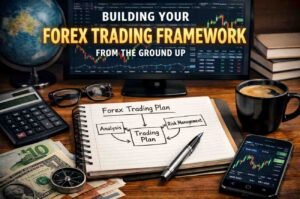
Successful forex trading is not gambling; it’s a probability-based business. It requires a systematic framework that removes guesswork and emotion. Here is the logical, step-by-step progression you must follow.
1. Understanding the Forex Market Foundation
How to trade in forex trading: the simultaneous buying of one currency and selling of another. These currencies are traded in pairs (e.g., EUR/USD, GBP/JPY). The first currency is the “base,” and the second is the “quote.” The price tells you how much of the quote currency you need to buy one unit of the base.
2. The Core Pillars of Analysis
Your trading decisions should be informed by one or both of these analytical approaches.
| Analysis Type | What It Studies | Key Tools & Indicators | Time Horizon |
|---|---|---|---|
| Technical Analysis | Historical price action and volume to forecast future movements. | Chart patterns, Support/Resistance, Moving Averages, RSI, MACD | Short to Medium-term (Minutes to Weeks) |
| Fundamental Analysis | Economic, social, and political forces that affect currency supply and demand. | Interest Rates, GDP, Inflation Reports (CPI), Employment Data, Geopolitical Events | Medium to Long-term (Days to Years) |
3. The Non-Negotiable: Risk Management
This is the most critical component of your logic. No strategy survives without it.
- Risk-Per-Trade: Never risk more than 1-2% of your total trading capital on a single trade.
- Stop-Loss Orders (SL): A mandatory order that automatically closes a losing trade at a predetermined level to prevent catastrophic losses.
- Take-Profit Orders (TP): An order to close a profitable trade at a specific level, locking in gains and removing emotion.
- Leverage Wisdom: Leverage (like 50:1 or 100:1) is a double-edged sword. It amplifies both gains and losses. Use it sparingly until you are highly experienced.
4. Developing and Testing a Trading Plan
- Market Conditions: When will you trade? (e.g., high volatility sessions like the London-New York overlap).
- Entry & Exit Rules: Precise criteria for entering a trade (trigger) and your SL/TP levels.
- Position Sizing: How many lots or units you will trade based on your risk percentage.
- Backtesting & Demo Trading: Test your plan rigorously on historical data and then in a risk-free demo account for at least 2-3 months. This is your practice runway.
The Emotion: Mastering Your Inner Trader
Logic builds the machine, but emotion is the operator. The market is a mirror of human psychology fear and greed are its primary drivers. Recognizing this is your greatest edge.
The Thrill of the Win: A successful trade brings a surge of confidence. This emotion, unchecked, can morph into overconfidence, leading you to abandon your plan, increase risk recklessly, and take low-probability trades. You must learn to treat
Conclusion
How to trade in forex trading offers significant opportunities for profit, but it requires a solid understanding of the market, disciplined strategies, and effective risk management. By following an essential guide, new traders can gain the knowledge and confidence needed to make informed decisions, control their emotions, and navigate the market successfully. Consistent practice and patience are key to turning learning into long-term trading success.
